TL;DR
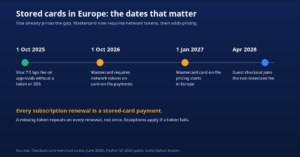
- From October 2026, Mastercard expects merchants to send a Transaction Link Identifier (TLID) on subscription renewals and other merchant-initiated payments, with non-compliance fees starting in January 2027.
- The identifier must persist across every system that touches a payment: billing, gateway, orchestration layer, and processors. A single dropped hop breaks the link.
- Businesses that route renewals across several providers or several countries have the most places where the identifier can get lost.
What is changing
The Transaction Link Identifier (TLID) is a unique reference that Mastercard generates for a card-not-present authorization. It ties later payments back to the original cardholder authorization. From October 2026, merchants must include it on every “economically related” transaction, a category that covers subscription payments, buy-now-pay-later arrangements, and other merchant-initiated transactions (MITs), which are payments the merchant triggers without the customer present (Checkout.com).
The mandate applies globally to Mastercard card-not-present MITs, including recurring subscriptions, standing orders, and unscheduled credential-on-file payments. It covers Mastercard, Debit Mastercard, and Maestro (Solidgate documentation).
Enforcement runs through Mastercard’s data integrity monitoring, and fees for non-compliance start in January 2027. Missing identifiers after October 2026 may also lead to scheme fines or higher issuer decline rates (Cardtraq). Providers publish slightly different milestone dates for the rollout, so confirm the exact dates with your acquirer.
Why this is an architecture problem, not a field-mapping task
Sending a new field is easy. Keeping it alive is not. As Cardtraq puts it, “TLID has to persist across every integration point: gateways, orchestration layers, processors, sub-processors.”
Checkout.com’s guidance adds a storage point: merchants should store the identifier for every transaction, plan for an additional 36-character string in their databases, and keep both the older Trace ID and the TLID during the transition. For cards saved before TLID existed, the merchant sends one MIT, receives the generated identifier back through the acquirer, and stores it.
A concrete failure case: a customer subscribes in Germany in March. In July, the renewal soft-declines (a temporary decline the issuer may approve on a later attempt) and retries through a second provider. If the billing system stored the identifier but the retry path never passed it along, the second attempt arrives with no link to the original payment. Multiply that by every retry, every provider, and every country.
How orchestration architecture absorbs this
Two SGW Payment capabilities matter here, and both are about where the payment’s history lives.
First, a single SDK and API connects a merchant to a network of payment providers. When one integration point sits in front of many providers, there is one place where a stored reference can be held and handed to whichever provider processes the next renewal. Without it, each provider integration is a separate place for the identifier to be dropped.
Second, SGW routes each transaction to the provider most likely to approve it. Routing and retrying across providers is exactly the situation where a payment’s history has to travel with it. Any routing design has to treat that history as part of the transaction.
For businesses expanding internationally, the exposure grows. SGW stands up the local payments setup in each new market, including banking and acquiring relationships and PSP contracts, so transactions process locally rather than cross-border. Each new country adds provider relationships, and each one is another hop the identifier must survive. Standing that up yourself would otherwise take 6 to 12 months per market.
Takeaways you can act on this quarter
- Map every system that touches a renewal: billing, gateway, orchestration, each processor. Mark where the first-payment reference is stored and where it is passed on.
- Check with your acquirer and processors which exact Mastercard dates and assessment rules apply to you.
- Add storage for a 36-character identifier and keep Trace ID alongside it during the transition.
- Plan the backfill for existing subscribers: one MIT per saved card to obtain and store the identifier.
- Test retries across providers and regions, not just the happy path on your primary provider.
- When you enter a new market, ask how the identifier will move through the new provider chain before go-live. Budget 6 to 12 months if you build that setup yourself.
Sources
- Payment tracking update: What is Mastercard TLID? (Checkout.com)
- Mastercard TLID fees start in 2027 (Cardtraq, April 23, 2026)
- Mastercard TLID (Solidgate documentation)
About SGW Payment. SGW Payment helps online businesses capture more revenue and reduce processing costs. Through a single SDK and API, SGW connects merchants to a network of payment providers and routes each transaction to the provider most likely to approve it. On top of the technology, SGW acts as the payments infrastructure layer for international expansion, standing up the local payments stack (entity, banking, acquiring, and finance operations) in every new market, so transactions process locally rather than cross-border. Learn more at sgw-payment.com.