TL;DR
- Since 1 October 2026, Mastercard requires Credential-On-File transactions in Europe to be processed with network tokens, with exceptions.
- Visa already charges 7.5 basis points on domestic and intraregional approvals without a token or 3DS. Mastercard adds card-on-file pricing in Europe from January 2027.
- Subscription renewals are stored-card payments, so they carry the exposure. Audit your token coverage this quarter.
What changed
Mastercard now requires Credential-On-File (CoF) transactions in the Europe region to be processed with network tokens, effective 1 October 2026. Credential-On-File means a payment made with card details the merchant stored earlier, which describes every subscription renewal. A network token is a substitute for the card number, issued by the card network. Countries already under a domestic mandate are excluded, and the requirement does not apply “if the issuer declines the token transaction, there is no active token available, or an attempt to tokenize failed” (Checkout.com merchant notice, 10 June 2026).
Visa’s Europe framework already prices the same gap. Per the same notice, a 7.5 basis point fee (0.075%, or 7.5 cents per 100 euros) applies to domestic or intraregional approved authorizations processed without network tokens or 3DS. 3DS is the extra authentication step a cardholder completes online.
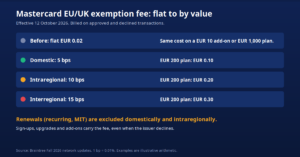
PayPal’s fall 2026 card-network guide, dated September 2026, adds a pricing change that starts on 1 January 2027: Mastercard card-on-file pricing in Europe, with a Germany domestic and intraregional card-on-file rate of 7 basis points (capped at 70 euros) and a rest-of-Europe rate of 5 basis points (capped at 25 euros). The guide also lists a no-authentication rate of 5 basis points from January 2027 and later steps through April 2030 (PayPal guide). Subscription Insider reads these changes as applying to card-on-file transactions that are not tokenized, and notes that the actual impact depends on your processor, acquirer, and pricing agreement (Subscription Insider, 7 September 2026).
The timeline in one place
- 1 October 2025: Visa’s 7.5 basis point fee on tokenless, 3DS-less domestic and intraregional approvals in Europe (Checkout.com notice).
- 1 October 2026: Mastercard requires network tokens on Credential-On-File transactions in Europe.
- 1 January 2027: Mastercard card-on-file pricing starts in Europe (PayPal guide).
- April 2028: guest checkout joins the non-tokenized fee, renamed Not Tokenized Card Not Present (PayPal guide).
Analysis: the renewal is where tokens pay or cost
A subscription business charges the same stored card again and again. A single missing token therefore repeats on every renewal, not once. That is why the stored-card file is the unit to audit, not the checkout page.
The per-transaction numbers look small. The arithmetic is not. Take 100,000 monthly renewals of 30 euros at 5 basis points: each carries 1.5 cents, or 1,500 euros a month. This is illustrative arithmetic, not a rate in your contract, and your acquirer may pass fees through differently.
The exceptions matter too. A token request can fail, an issuer can decline a token, and older stored cards may have no token at all. So a mandate does not mean every card is covered on day one. The practical task is to measure what share of your stored cards carries a token, by country and by card network, and to chase the gap.
The rules also differ by region. The same Checkout.com notice lists a 4 basis point fee on non-tokenized card-on-file payments in parts of Asia Pacific, a 5 basis point fee on non-tokenized e-commerce in the UAE from 4 January 2027, and a Visa fee of 5 basis points on card-on-file payments without tokens in the UAE from 17 October 2026. A business that expands across regions meets a different token rule in each.
How SGW addresses this
Two SGW Payment capabilities map to this kind of change.
First, SGW acts as the payments infrastructure layer for international expansion. When a client enters a new market, SGW stands up the local setup on their behalf: entities where required, banking and acquiring relationships, PSP contract negotiation in the jurisdiction, and finance operations such as reconciliation, reporting, and local tax clearance. Transactions then process locally rather than cross-border, so a new token rule lands on a setup built for that market.
Second, a single SDK and API connects clients to a network of payment providers, and SGW routes each transaction to the provider most likely to approve it. That lifts success rates and lowers the fees paid on each payment. For renewals, it means the provider choice is made per transaction, not fixed at integration time.
Takeaways you can act on this quarter
- Measure token coverage: what share of your stored European cards carries a network token, split by country and network?
- Ask your acquirer in writing how Mastercard’s January 2027 card-on-file pricing will appear on your statement.
- Check how your billing system handles a failed or declined token request, so the renewal still goes through.
- Model the fee for your renewal volume using your own rates, not the illustrative ones in this article.
- If you are expanding into a new market, budget 6 to 12 months to stand up local processing yourself, because token and fee rules will keep changing while you build.
Sources
- Reminder: Network tokens incentives and fees (Checkout.com merchant communications, 10 June 2026)
- Card Network Updates: Fall 2026 Release Guide (PayPal, September 2026)
- Card-Network Changes Tie More Costs to Payment Setup (Subscription Insider, 7 September 2026)
About SGW Payment. SGW Payment helps online businesses capture more revenue and reduce processing costs. Through a single SDK and API, SGW connects merchants to a network of payment providers and routes each transaction to the provider most likely to approve it. On top of the technology, SGW acts as the payments infrastructure layer for international expansion, standing up the local payments stack (entity, banking, acquiring, and finance operations) in every new market, so transactions process locally rather than cross-border. Learn more at sgw-payment.com.