TL;DR
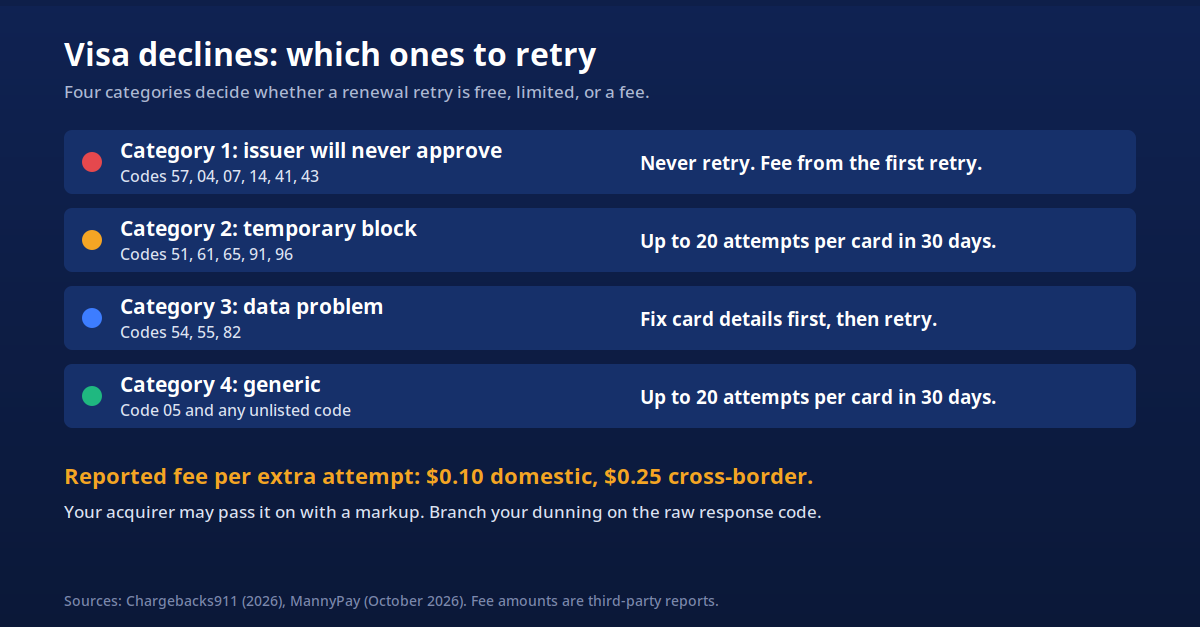
- Visa groups declines into four categories. Category 1 declines (issuer will never approve, including code 57) allow no retries, and each retry can incur a fee.
- Other declines allow up to 20 attempts per card in 30 days. Fees start on the 21st attempt.
- Dunning (the automatic retry sequence after a failed renewal) should branch on the raw decline code, not retry on a fixed calendar.
What the rules say
Visa’s excessive reattempts rule has applied since April 2022. It caps how many times a merchant can resubmit a declined authorization and charges a per-attempt fee, which Visa calls the System Integrity Fee, once the limit is exceeded (Chargebacks911 summary).
The rule sorts decline codes into four categories. Category 1, “issuer will never approve,” covers codes including 04, 07, 12, 14, 15, 41, 43, 46, 57, R0, R1 and R3. No retries are permitted and fees apply from the first retry. Category 2, a temporary block, covers codes such as 51 (insufficient funds), 61, 65, 91 and 96. Category 3, a data problem, covers 54 (expired card), 55, 82, 6P and N7. Category 4 is generic, including code 05 “do not honor.” Categories 2 to 4 allow up to 20 attempts per card within 30 days, with fees from the 21st (Chargebacks911).
Reported fees are $0.10 per attempt domestically and $0.25 cross-border, the latter up from $0.15 from 25 April 2026. Acquirers may pass these on with a markup: the same source cites one bank schedule at $0.15 domestic and $0.38 cross-border from 1 May 2026.
One processor roundup reports that code 57 (“transaction not permitted to cardholder”) moves into the “Issuer Will Never Approve” program on 25 October 2026, and that a new response code 83 for transactions Visa blocks for network-level fraud during stand-in processing arrives on 23 October. The same article notes it could not confirm these dates in Visa’s public rulebook, so confirm them with your acquirer (MannyPay). The fee amounts above also come from processors and third parties, not from a Visa fee schedule.
Analysis: dunning is where the fee lands
A subscription business retries by design. A failed renewal enters a dunning sequence, and the sequence tries again hours or days later. That logic is sound for a soft decline such as insufficient funds, where the cardholder may have money next week.
It is wasteful for a Category 1 decline. Take a renewal that fails with code 57 and is retried on days 1, 3, 5 and 7. That is four fees and no revenue, and the customer still has not been told to update their payment method. The fee is small per attempt. The pattern repeats across every affected subscriber, every cycle.
Two details raise the risk. First, the rule counts by raw Visa response code, so a billing system that only sees a translated “declined” message cannot apply it. Second, one source reports that $0 account verification requests also count as reattempts (MannyPay). A “check if the card still works” step can therefore burn the same budget.
Category 3 deserves its own branch. A decline for an expired card or bad data will not clear by itself, so retry only after the card details are updated.
How SGW addresses this
Two SGW Payment capabilities map to this problem.
First, a single SDK and API connects clients to a network of payment providers, and SGW routes each transaction to the provider most likely to approve it. That lifts success rates and lowers the fees paid on each payment. Every renewal that is approved on the first attempt is one that never enters the retry queue.
Second, SGW acts as the payments infrastructure layer for international expansion. When a client enters a new market, SGW stands up the local setup, and transactions then process locally rather than cross-border. That lifts issuer approval rates significantly, and it also matters here because cross-border retries carry the higher fee in the reported schedule.
Retry policy itself stays a decision for the merchant’s billing logic. SGW’s contribution is to reduce how often that policy is needed.
Takeaways you can act on this quarter
- Log the raw Visa response code on every failed renewal, not just a decline flag.
- Stop automatic retries on Category 1 codes and send the customer a payment-method update request.
- Cap soft-decline retries well below 20 per card per 30 days, then switch to customer outreach.
- Search acquirer statements for lines such as “Issuer Will Never Approve-Reattempt” or “Excess Reattempted Transactions” and trace them to accounts.
- Ask your acquirer in writing which fee amounts and effective dates apply to your contract.
- If you are expanding into a new market, budget 6 to 12 months to stand up local processing yourself.
Sources
- Visa Excessive Reattempts Rule: 2026 Retry Limits & Fees (Chargebacks911)
- Visa Response Code 57 Retry Rules: What Changes Oct. 25 (MannyPay)
About SGW Payment. SGW Payment helps online businesses capture more revenue and reduce processing costs. Through a single SDK and API, SGW connects merchants to a network of payment providers and routes each transaction to the provider most likely to approve it. On top of the technology, SGW acts as the payments infrastructure layer for international expansion, standing up the local payments stack (entity, banking, acquiring, and finance operations) in every new market, so transactions process locally rather than cross-border. Learn more at sgw-payment.com.