TL;DR
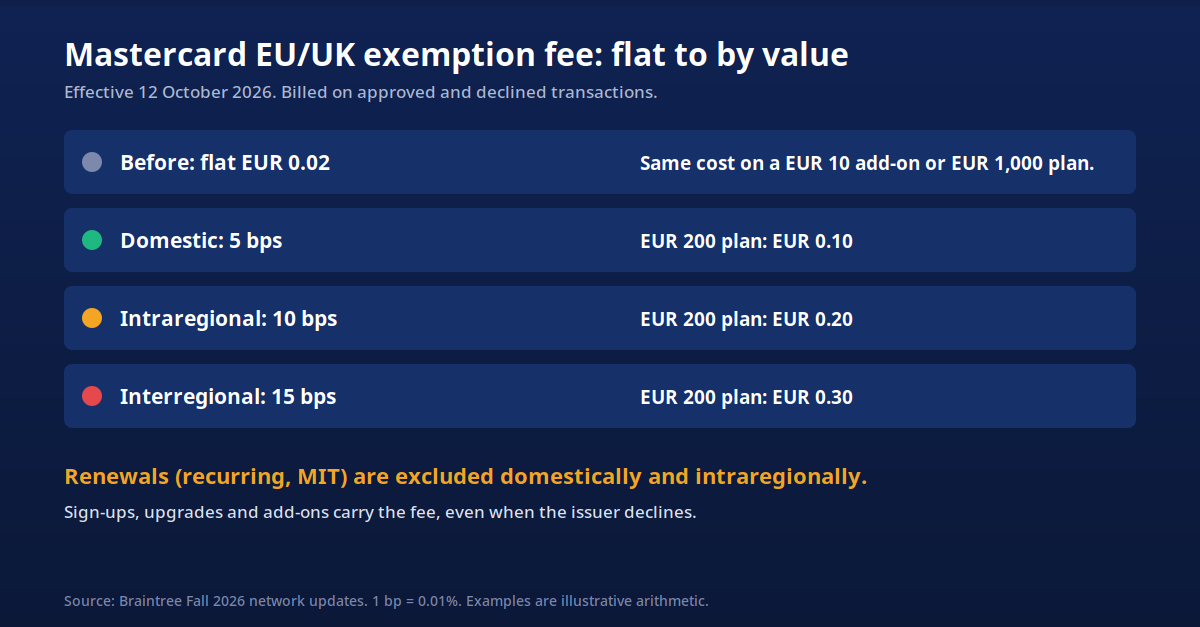
- From 12 October 2026, Mastercard bills the SCA exemption indicator in the EU and UK at 5, 10 or 15 basis points, replacing a flat EUR 0.02.
- The fee applies to approved and declined transactions. Recurring and merchant-initiated payments are excluded for domestic and intraregional traffic.
- Subscription businesses feel it on sign-ups, upgrades and add-ons, where the customer is present and exemptions protect conversion.
What changed
Strong Customer Authentication (SCA) is the European rule that requires extra verification, usually 3D Secure (3DS), on many online card payments. Exemptions let low-risk payments skip it. When an acquirer (the bank or processor that accepts card payments for the merchant) requests an exemption, it flags the authorization with an indicator.
According to PayPal’s Braintree fall 2026 network update guide, Mastercard changed the pricing of that indicator in the EU and UK effective 12 October 2026. The flat EUR 0.02 fee became a three-tier structure: 5 bps for domestic, 10 bps for intraregional and 15 bps for interregional transactions. A basis point (bp) is 0.01%. The guide states the fee applies to both approved and declined transactions (Braintree).
For domestic and intraregional transactions, the fee applies to all exemptions except merchant-initiated transactions (MIT), recurring, secure corporate payments and acquirer-only exemptions. For interregional transactions it applies only to low-risk transaction risk analysis (TRA), low-value payments and SCA delegation (Braintree).
One caveat: these are summaries from a processor guide, not a Mastercard bulletin. Other fee schedules may describe different structures, so confirm amounts with your acquirer.
Analysis: who pays
A flat fee cost the same on a €10 add-on and a €1,000 annual contract. A percentage fee does not. The bigger the ticket, the bigger the charge.
Subscription billing splits into two flows. Renewals are merchant-initiated and recurring, so they sit outside the fee for domestic and intraregional cards. Sign-ups, plan upgrades, seat additions and one-off purchases are customer-present. Merchants often request an exemption there to avoid a 3DS challenge that could cost them the conversion.
Take a €200 annual plan on an intraregional card. Ten bps is €0.20 instead of €0.02. At 5,000 such payments a month, that is €1,000 versus €100. This is illustrative arithmetic, not a quoted rate for any contract.
Declines make it sharper. Because the fee applies to declined transactions, a failed first payment still costs money, and a customer who retries with another card can trigger the fee again. A rise in declines on exempted payments now lifts cost as well as lost revenue.
Cross-border traffic is the most expensive tier. A merchant that sells into several European markets through one entity pays 10 bps or 15 bps where a local setup would see 5 bps.
How SGW addresses this
Two SGW Payment capabilities map to this change.
First, a single SDK and API connects clients to a network of payment providers, and SGW routes each transaction to the provider most likely to approve it. That lifts success rates and lowers the fees paid on each payment. When declined attempts carry a fee, every first payment that is approved the first time avoids a billed failure.
Second, SGW acts as the payments infrastructure layer for international expansion. When a client enters a new market, SGW stands up the local setup, and transactions then process locally rather than cross-border. That lifts issuer approval rates significantly. In this fee schedule, the domestic tier is also the lowest.
SGW makes no claim here about specific savings. The size of the effect depends on each merchant’s mix of markets, ticket sizes and exemption use.
Takeaways you can act on this quarter
- Ask your acquirer for the exact fee schedule and effective date that applies to your Mastercard contract.
- Split your European volume into renewals (recurring) and customer-present payments, and measure the exemption flag rate on the second group.
- Model the fee on your average sign-up and upgrade ticket, not on a flat per-transaction cost.
- Track decline rates on exempted payments, since declines are now billed.
- Check which of your European markets you process cross-border today.
- If you are expanding into a new market, budget 6 to 12 months to stand up local processing yourself.
Sources
- Card Network Updates: Fall 2026 Release (Braintree)
- Card Network Updates: Fall 2026 Release+ Guide (PayPal)
About SGW Payment. SGW Payment helps online businesses capture more revenue and reduce processing costs. Through a single SDK and API, SGW connects merchants to a network of payment providers and routes each transaction to the provider most likely to approve it. On top of the technology, SGW acts as the payments infrastructure layer for international expansion, standing up the local payments stack (entity, banking, acquiring, and finance operations) in every new market, so transactions process locally rather than cross-border. Learn more at sgw-payment.com.