TL;DR
- On 4 May 2026, Mastercard announced a partnership with Fraud Deflect, integrated into Mastercard’s Ethoca Consumer Clarity Smart Subscriptions, a subscription-management layer embedded inside cardholder banking apps. When a customer taps “dispute” on a recurring charge from inside the app, the merchant gets a window to resolve directly before the dispute becomes a chargeback.
- Mastercard’s own framing: about a quarter of its chargebacks come from recurring transactions tagged as cancellation confusion or forgotten purchases, against a backdrop of 8+ active subscriptions per US consumer and roughly $118 a month in subscription spend.
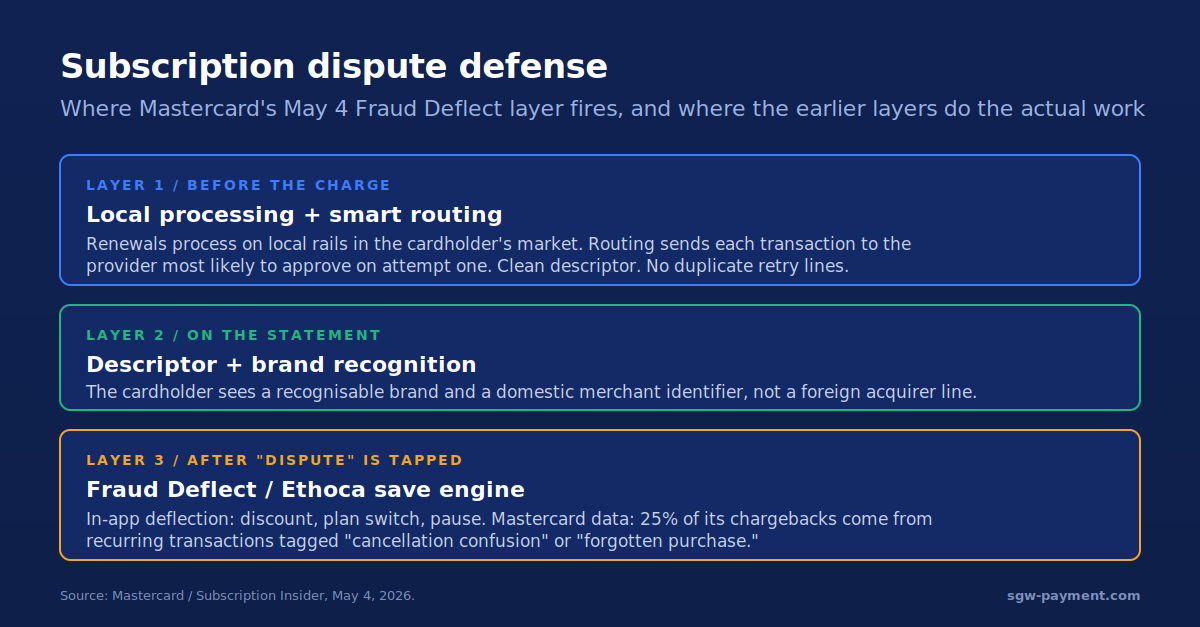
- The mechanism is a downstream save: it fires once the cardholder is already on the dispute path. The cheaper dispute is the one that never starts, which is an upstream payment-quality story (descriptor, local acquirer, retry sequencing) rather than a save-engine story.
Context: what Mastercard actually announced
The May 4, 2026 announcement extends Mastercard’s existing Ethoca dispute-prevention stack with Fraud Deflect, a partner whose product sits inside the moment a cardholder is about to file a recurring-payment dispute.
The integration runs inside the issuer’s mobile banking app. A cardholder browsing recent transactions sees the recurring charge, taps “I don’t recognize this” or its equivalent, and instead of being routed straight to the chargeback flow, gets an inline option to:
- See the merchant’s contact channel and resolve directly.
- (Planned) accept a discount on the next renewal.
- (Planned) downgrade to a lower-priced plan.
- (Planned) pause the subscription instead of cancelling.
Mastercard’s framing draws on its own data: about one in four of its chargebacks come from recurring transactions where the dispute tag is “cancellation confusion” or “forgotten purchase.” The macro context cited in the announcement: 8+ active subscriptions per US consumer, around $118 a month in subscription spend, and a “subscription fatigue” backdrop where the path of least resistance for the cardholder is to challenge the line item rather than open a support ticket with the merchant.
The product itself is not new in concept. Ethoca Consumer Clarity has been the issuer-side merchant-name and detail lookup layer for years. What changed on May 4 is the addition of save-action plumbing on top of it: not just “here’s who you paid,” but “here is what the merchant is willing to do to keep you.”
Analysis: a save tool is not a defense strategy
For subscription billing teams, the announcement reads better as a shift in the dispute landscape than as a new lever to pull.
The save mechanism activates after three things have already happened.
The renewal was charged. The cardholder noticed it on the statement. The cardholder decided the charge was wrong, unwanted, or unfamiliar enough to push back. By the time Fraud Deflect surfaces an offer inside the bank app, the merchant is bidding for retention against a buyer who has already left in their head.
Two practical consequences flow from that timing.
First, the unit economics of “preserving the relationship” through save-engine discounts and pauses are not free. A discount on the next renewal trades MRR. A plan downgrade trades ARPU. A pause defers churn rather than preventing it. Each of these is better than a chargeback (which costs the original amount plus fees plus a hit to the merchant’s chargeback ratio), but each is worse than a renewal that processed cleanly and was never disputed.
Second, the save engine only catches the disputes that route through the issuer’s banking app interface. A growing share of cardholder behaviour starts with the cardholder Googling the merchant name on the statement, finding no obvious match, and disputing via call centre or web form. Those flows still exit the merchant’s funnel without a save offer being shown.
The strategic question this surfaces for subscription billing is upstream: how many of the disputes Fraud Deflect now catches were avoidable at the moment the renewal was processed in the first place?
Most of them have one or more of the following shapes:
- The statement descriptor on the renewal was unrecognisable to the cardholder (cross-border processing routes the transaction through a foreign-merchant or foreign-acquirer identifier rather than the brand the cardholder signed up with).
- The renewal had been declined and retried, with the retry processed on a different provider whose descriptor read differently from the original signup charge.
- The price had changed since signup and the cardholder did not connect the new amount to the brand they recognised.
- The renewal succeeded long after the cardholder considered themselves cancelled (a free trial converting late, a paused account auto-resuming).
None of these are issuer-side problems. They are merchant-side payment-quality problems. The Fraud Deflect / Ethoca layer is a useful net at the bottom of the cliff. The structural lever sits at the top.
How orchestration and local processing absorb this upstream
The upstream defense for a subscription billing stack against the disputes Mastercard’s data points to is a payment architecture that minimises the gap between the merchant the cardholder thinks they pay and the entity that actually charges them. The two SGW capabilities below map directly to that gap.
- Routing each transaction to the provider most likely to approve. A first-attempt approval is the cleanest defense against the dispute path. Soft-declined renewals that bounce across multiple retries each produce a separate statement line; even when they ultimately succeed, the cardholder sees a sequence of “attempted” or “pending” entries that read as duplicate charges. Routing the renewal to the provider with the highest probability of approval, on the issuer’s BIN, on the first attempt, collapses that sequence back to one clean line item. Fewer attempts means fewer descriptor variations and less of the “why am I being charged again” reflex Mastercard tags as cancellation confusion.
- Local processing in every market, not cross-border. When a UK cardholder’s subscription renewal clears through a UK acquirer on UK rails, the statement descriptor and the issuer’s recognition heuristics both read “domestic merchant.” When the same renewal is cross-border processed out of a single foreign PSP, the descriptor lights up as foreign, the issuer’s fraud signal is mildly elevated, and the cardholder is more likely to query the charge. SGW stands up the local payments stack in each market a subscription business sells into (entity, banking, acquiring, PSP contracts, and the finance operations behind them), so renewals process domestically on local rails wherever the cardholder actually lives. As a side effect, processing locally rather than cross-border lifts issuer approval rates significantly on its own. The approval-rate lever and the dispute-reduction lever are the same architectural choice.
- One integration, one finance ops surface. A subscription business running on local processing across multiple markets does not have to integrate to a different PSP per country or stitch together its own reconciliation between them. SGW connects the merchant through a single SDK and API to a network of providers, with reconciliation, cash flow, reporting, and local tax clearance running on top in every jurisdiction it processes in. That same finance-ops surface is where dispute response, chargeback reason-code reconciliation, and Ethoca-style data feeds are operationally absorbed.
The point is not that the Mastercard / Fraud Deflect layer is wrong. It is that it is a layer. It catches a slice of disputes that already started. The architectural choice to process renewals locally, route them to the provider most likely to approve, and consolidate the finance operations around them prevents a meaningful share of those disputes from being filed at all.
Takeaways: five questions to ask before relying on Fraud Deflect
- Descriptor audit. Pull the last 100 chargebacks tagged as “cancellation confusion” or “do not recognise.” How many show a statement descriptor that does not include the recognisable brand name and a local merchant identifier?
- Cross-border share. What percentage of renewals from cardholders in your top three markets are still processed cross-border through a single PSP, rather than locally in each market?
- Retry sequencing. When a renewal soft-declines and retries, does the retry go to a different provider whose descriptor reads differently from the original charge? How often does that produce two visible statement lines?
- Save-cost economics. For the disputes Fraud Deflect would now catch in-app, what is the average MRR cost of the discount, pause, or plan switch needed to retain the cardholder? How does that compare with the cost of preventing the dispute upstream through descriptor and routing quality?
- Build vs. partner on local processing. If the answer is to move renewals onto local rails in two or three more markets, the realistic in-house timeline is 6 to 12 months per market (entity setup, banking, acquiring, contract negotiation, and finance operations on top). An orchestration and infrastructure partner that already runs that stack converts that year of work into a routing-rule update.
Sources
- Subscription Insider: Mastercard and Fraud Deflect target subscription chargebacks before they become disputes
- Mastercard Global Newsroom: How to prevent subscription chargebacks before they happen
- Mastercard: Revised standards for subscription, recurring payments, and negative option billing merchants (PDF)
- Mastercard: Dispute management and post-purchase experience
About SGW Payment. SGW Payment helps online businesses capture more revenue and reduce processing costs. Through a single SDK and API, SGW connects merchants to a network of payment providers and routes each transaction to the provider most likely to approve it. On top of the technology, SGW acts as the payments infrastructure layer for international expansion, standing up the local payments stack (entity, banking, acquiring, and finance operations) in every new market, so transactions process locally rather than cross-border. Learn more at sgw-payment.com.