TL;DR
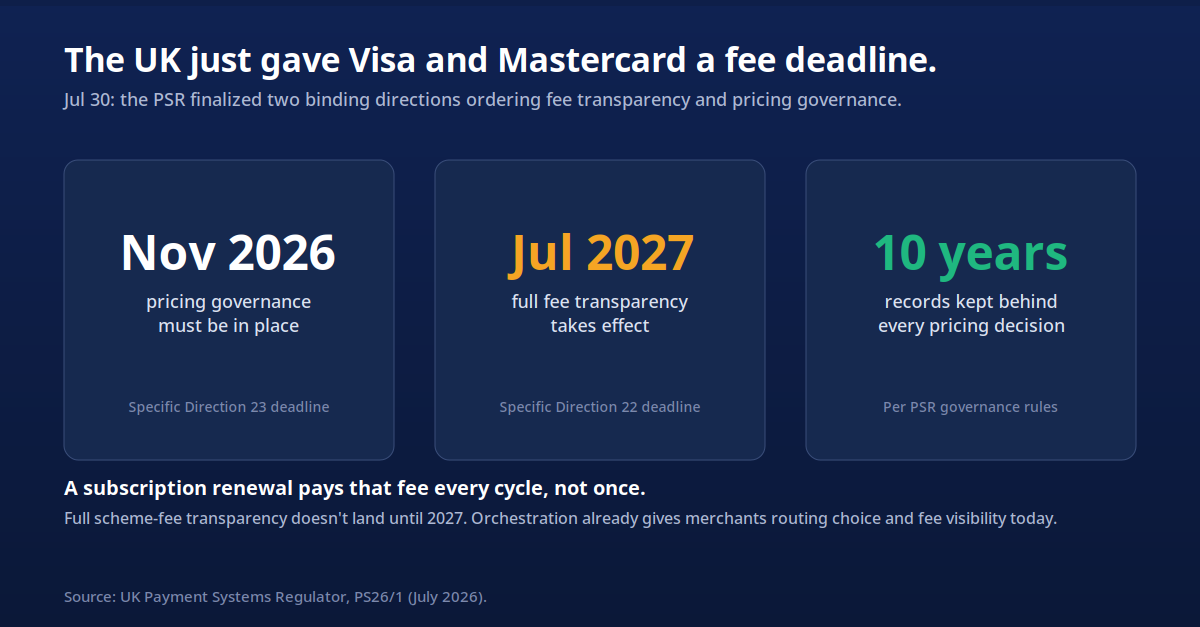
- On July 30, 2026, the UK’s Payment Systems Regulator (PSR) finalized two binding directions ordering Visa and Mastercard to disclose how they set the scheme fees charged to acquirers on UK card transactions, with compliance deadlines running from November 2026 through July 2027.
- The PSR’s own finding: the two networks face no real competitive pressure, fees have risen, and acquirers cannot clearly work out what they are being charged or why.
- For subscription businesses, undocumented scheme fees do not hit once at checkout. They repeat on every renewal, so the same fee opacity compounds against monthly recurring revenue (MRR) for the life of a customer, well before UK acquirers get full transparency in 2027.
What happened
On July 30, 2026, the UK’s Payment Systems Regulator (PSR) published its final decision (PS26/1) closing a multi-year market review into card scheme and processing fees. The regulator issued two binding directions to Visa and Mastercard under section 54 of the Financial Services (Banking Reform) Act 2013.
Specific Direction 22 targets transparency. It requires the schemes to give acquirers, the banks and processors that take card payments on a merchant’s behalf, enough detail on every fee to work out what triggered it, forecast what it will cost, and reconcile it against a billing period. Schemes must classify each fee, describe the activity that triggers it, and disclose rates and pricing structures. Full compliance is due by July 30, 2027.
Specific Direction 23 targets governance. Every pricing decision now needs a documented, auditable case: purpose, structure, approval basis, expected revenue impact, and cost linkage, with records retained for ten years. Pricing governance processes must be in place by November 30, 2026.
Interim milestones sit between the two deadlines: schemes must write to acquirers with a proposed compliance approach by October 30, 2026, and report acquirer feedback by January 30, 2027. A third remedy on regulatory financial reporting is still in consultation (CP26/1) and was not finalized alongside these two.
The PSR’s underlying finding, stated plainly in its own review, is that “Mastercard and Visa don’t face competition, with fees rising and a lack of clarity on how much businesses will have to pay to accept card payments.” The regulator found no clear evidence that fee increases track cost, competition, or innovation.
Why this is a subscription-billing problem, not just a UK acquiring dispute
Scheme fees sit on top of interchange, the per-transaction fee card issuers already collect, as a separate line item that acquirers pass through to merchants. For a one-off retail purchase, an unclear or rising fee is a rounding error on a single receipt. A merchant absorbs it, adjusts pricing, and moves on.
A subscription business does not get that luxury. The same card, the same fee schedule, and the same lack of clarity apply to every renewal a customer generates for as long as they stay subscribed. A fee increase that looks trivial on one transaction becomes a recurring drag on monthly recurring revenue (MRR) the moment it repeats across a customer base measured in months of average retention.
The PSR’s own timeline underscores the gap. Full fee transparency does not land until July 2027, nearly two years from now. Until then, UK acquirers, and the subscription merchants behind them, are working from the same fee opacity the regulator just spent years documenting. A finance team modeling card-processing costs for 2026 and 2027 has to do so without the forecasting detail SD22 is designed to eventually provide.
How orchestration architecture addresses this
Waiting for scheme-level transparency is not the only lever available to a subscription merchant today. Payment orchestration works underneath the fee-disclosure question by giving merchants their own routing choice and their own reconciliation view, transaction by transaction, rather than depending on Visa or Mastercard’s own disclosure timeline.
SGW Payment connects merchants to a network of payment providers through a single SDK and API integration, and routes each transaction to the provider most likely to approve it, which lifts success rates and lowers the fees paid on each payment. That decision happens on every renewal, not once at account setup, and it does not require SD22’s 2027 compliance date to already produce cost visibility for the merchant.
The same logic extends across jurisdictions. SGW acts as the payments infrastructure layer for international expansion: standing up the local entity, banking, acquiring relationships, and PSP contracts a merchant needs in each new market, then running the downstream reconciliation, cash flow, reporting, and local tax clearance behind those transactions. Processing locally in each market rather than cross-border lifts issuer approval rates significantly on its own, and that gain compounds with the routing layer to produce top-of-market success rates across a merchant’s footprint. A business standing up that local infrastructure alone would otherwise need 6 to 12 months per market; orchestration compresses that timeline by handling the setup on the merchant’s behalf.
To be precise about scope: this analysis does not claim any specific SGW fee-reduction percentage, and SGW does not lobby on or take a position on UK payments regulation. The claim is structural: fee visibility and routing choice are capabilities orchestration already gives a merchant today, independent of when a scheme’s own transparency obligations take effect.
Takeaways you can act on this quarter
- Model scheme fees as a recurring MRR line, not a per-transaction rounding error. A fee increase that looks small on one sale compounds differently across a subscription base with months of average retention.
- Do not wait until July 2027 for fee forecasting. Build reconciliation visibility now, either internally or through a routing layer that already tracks what got charged, per provider and per jurisdiction.
- If you are expanding into a new market, price in the setup timeline. Standing up local banking, acquiring, and routing infrastructure from scratch typically takes 6 to 12 months; that timeline is itself a cost of not orchestrating from day one.
Sources
- PSR market review into card scheme and processing fees
- PS26/1 final decision: Information, Transparency and Complexity and Pricing Governance remedies (PSR, July 2026)
- Card scheme and processing fees: PSR deadlines (Bratby Law)
About SGW Payment. SGW Payment helps online businesses capture more revenue and reduce processing costs. Through a single SDK and API, SGW connects merchants to a network of payment providers and routes each transaction to the provider most likely to approve it. On top of the technology, SGW acts as the payments infrastructure layer for international expansion, standing up the local payments stack (entity, banking, and finance operations) in every new market, so transactions process locally rather than cross-border. Learn more at sgw-payment.com.