TL;DR
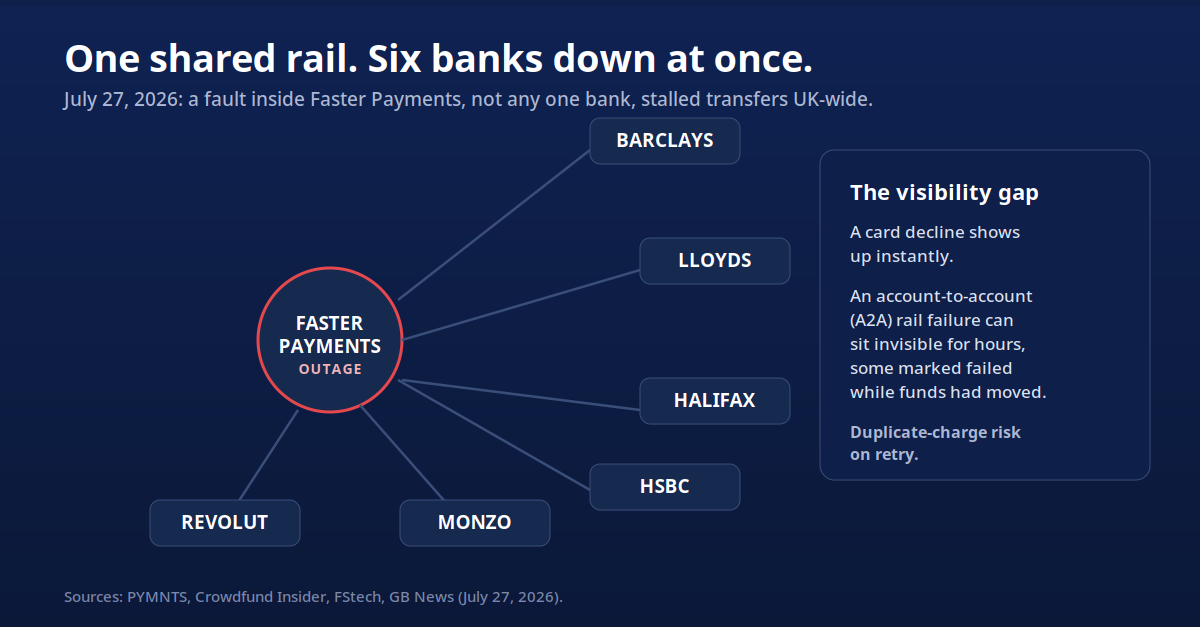
- On July 27, 2026, customers of Barclays, Lloyds, Halifax, HSBC, Monzo, and Revolut all reported failed or delayed transfers within the same afternoon. The common cause was a fault in Faster Payments, the UK’s shared interbank rail, not any single bank’s own systems.
- Six competing institutions failing together is what payment concentration risk looks like in practice: when an entire market routes through one shared rail, that rail’s bad afternoon becomes everyone’s bad afternoon.
- For subscription businesses collecting UK renewals by direct debit or open banking transfer, a rail-level outage is far harder to detect in real time than a card decline, and some affected transfers were shown as failed when funds had actually moved, a setup that risks duplicate charges on retry.
What happened
On Monday, July 27, 2026, customers of several of the UK’s largest banks, Barclays, Lloyds, Halifax, HSBC, Monzo, and Revolut, began reporting failed or delayed money transfers within the same window. Complaints on outage-tracking sites climbed steadily from around midday and peaked in the early afternoon, with hundreds of reports lodged against Barclays and Lloyds alone.
The pattern across the statements from each bank pointed to one cause. Lloyds said it was “investigating an issue affecting Faster Payments, which may cause delays.” Revolut told customers its team was “actively addressing a service disruption that may be affecting GBP transfers.” Barclays confirmed “some of our services have issues,” including account access problems on top of the transfer delays. Monzo reported it was “working on a fix to get us back up and running.”
Faster Payments is the infrastructure that moves money between UK bank accounts in near real time, the rail underneath most everyday bank transfers, standing orders, and a growing share of account-to-account (A2A) payments. It is not owned or operated by any single bank. That is precisely why a fault inside it can take down six competing institutions in the same afternoon: they are all customers of the same shared system.
By evening, the volume of new outage reports had declined and the banks indicated the underlying issue was resolved, though transfers initiated during the disruption needed extra processing time to clear. No public statement detailed the root cause of the fault itself.
Why this is a subscription-billing problem, not just a banking one
A single-bank IT failure is disruptive but contained. A rail-level failure is not. Every merchant, biller, and payroll system that depends on Faster Payments for that day’s transfers was exposed at the same time, regardless of which bank any individual customer holds an account with.
For subscription businesses, the exposure has a specific shape. Recurring billing in the UK increasingly runs on more than cards: direct debit (Bacs) and open banking transfers, including the Variable Recurring Payments (VRP) mechanism regulators have been pushing as a formal recurring-billing rail, both ultimately settle over the same shared interbank infrastructure that failed on July 27.
The visibility gap is the part that doesn’t show up in the outage headlines. A declined card produces an immediate, standardized response: the issuer says no, and the merchant’s system knows within seconds. An A2A transfer that fails inside Faster Payments does not behave the same way. It can sit in an ambiguous state for hours, and in this outage, some customers saw transfers marked as failed when the underlying funds had, in fact, already moved. A subscription billing system that automatically retries a “failed” renewal under that condition risks charging the customer twice, turning an infrastructure problem into a customer-trust problem.
None of this is a reason to avoid A2A or VRP as a UK billing option. It is a reason to not let any single rail, card, direct debit, or open banking transfer, carry all of a market’s recurring revenue with no fallback path and no independent way to confirm a payment’s true status.
How SGW’s infrastructure layer absorbs this
The mechanism that reduces this exposure is diversification at the transaction level, not a bet on which rail is safest. SGW Payment connects merchants to a network of payment providers through a single SDK and API, and routes each transaction to the provider most likely to approve it. That routing logic exists to lift approval rates day to day, but the same architecture means a merchant’s recurring revenue in a given market is never fully dependent on one processing path.
Layered on top, SGW’s role as the payments infrastructure layer for international expansion, standing up local entity, banking, and acquiring relationships, and running the finance operations behind them, means that infrastructure is already diversified across the client’s footprint before an incident like this happens. A merchant expanding into a new market avoids concentrating that market’s entire renewal volume in a single provider or a single rail from day one, rather than discovering the concentration risk during an outage.
To be precise about what this is not: SGW does not process Faster Payments transactions directly, and nothing here claims this specific outage would have been avoided. The claim is narrower and structural: recurring revenue that depends on exactly one channel, in exactly one market, has no fallback when that channel has a bad afternoon, and building in that fallback is what the orchestration and local-infrastructure model is for.
Takeaways you can act on this quarter
- Map which UK renewal payments ride which rail. Know, per payment method, whether a given renewal clears over card networks, Bacs direct debit, or an open banking A2A transfer, and therefore which of them share fate with a Faster Payments outage.
- Check what your dunning logic does with an ambiguous payment status. If a transfer shows as failed while funds have actually moved, an automatic retry creates a duplicate charge, not a recovered renewal.
- Don’t let one payment method carry 100% of a market’s recurring volume. A second path, even a manual fallback, turns a rail-level outage into a delay instead of a missed renewal.
- Price in the diversification, not just the primary rail’s uptime. Standing up a second, independent processing path in a market, or the local infrastructure to support one, is exactly the kind of build that otherwise takes 6 to 12 months to do from scratch.
Sources
- UK Banking Customers Face Transfer and Payment Glitches (PYMNTS, July 27, 2026)
- Major UK Banks Face Outages As Barclays, Halifax And Lloyds Clients Report Account Access Problems (Crowdfund Insider, July 2026)
- Payment outages affect users of banks including Lloyds and HSBC (FStech, July 2026)
- Barclays and Lloyds customers report payment problems as money fails to appear in accounts (GB News, July 2026)
About SGW Payment. SGW Payment helps online businesses capture more revenue and reduce processing costs. Through a single SDK and API, SGW connects merchants to a network of payment providers and routes each transaction to the provider most likely to approve it. On top of the technology, SGW acts as the payments infrastructure layer for international expansion, standing up the local payments stack (entity, banking, and finance operations) in every new market, so transactions process locally rather than cross-border. Learn more at sgw-payment.com.