TL;DR
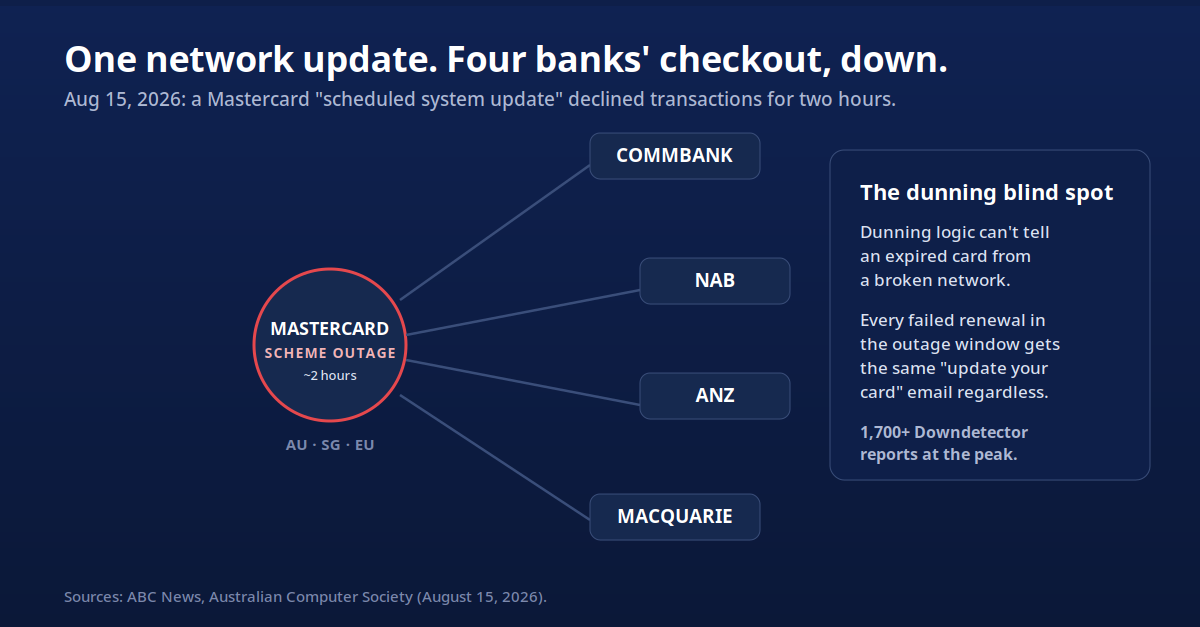
- On Saturday, August 15, 2026, a “scheduled system update” took Mastercard transactions offline across Australia for close to two hours, with reports also surfacing in Singapore and parts of Europe.
- Commonwealth Bank, NAB, ANZ and Macquarie all confirmed the fault sat with Mastercard’s own systems, not theirs. Card-present purchases, ATM withdrawals, Apple Pay and EFTPOS transactions all declined at once.
- For subscription billers, a scheme-level outage doesn’t read as a retail glitch. It reads as a wave of failed renewals that dunning systems can’t distinguish from ordinary card declines, unless a merchant’s routing already spans more than one provider.
What happened
On Saturday, August 15, 2026, Mastercard transactions began failing across Australia at around 2:25 PM local time. Commonwealth Bank, NAB, ANZ and Macquarie all reported the issue to customers, and each confirmed the fault sat with Mastercard’s network, not with their own banking systems.
The outage hit card-present purchases at point-of-sale terminals, ATM cash withdrawals, Apple Pay transactions and EFTPOS payments. Downdetector logged more than 1,700 user reports at the peak, a number that fell back to a small fraction of that within a few hours as the network recovered. Reports of the same disruption also surfaced in Singapore and parts of Europe, consistent with Mastercard describing the incident as affecting its broader network rather than one country’s infrastructure.
Mastercard’s own explanation was brief: “a scheduled system update caused Mastercard transactions to be declined for a period of time.” The company said systems were back to normal within roughly two hours of the first reports.
Why this is a subscription-billing problem, not just a Saturday-shopping problem
A retail outage is visible and short-lived. A shopper at a till either finds another way to pay or comes back later. A subscription renewal has no equivalent moment of visibility. It runs on a schedule the customer never sees, and it either authorizes or it doesn’t.
That distinction matters because of what happens after a decline. Dunning, the automated sequence of retries and “please update your payment method” emails that a failed renewal triggers, does not know why a card failed. A card that failed because it expired and a card that failed because the issuing network had a two-hour outage land in exactly the same queue, get the same retry logic, and can generate the same customer-facing email blaming a card that was never the problem.
At scale, that mislabeling has a cost. Every customer who receives an “update your card” email for a failure that was never theirs is a customer asked to take an action, and possibly reconsider a subscription, over an outage they had no part in. The correlation is also easy to miss internally: a spike in failed renewals in a two-hour window, concentrated in the countries an outage touched, can look like a normal, if unlucky, batch of card failures unless someone cross-references the timestamps against a scheme’s own status update.
The deeper issue is dependency concentration. Any merchant whose checkout and billing stack routes every transaction through a single card scheme by default inherits that scheme’s uptime as its own. A “scheduled system update” going wrong is not a rare or malicious event; it is routine infrastructure work that, on this occasion, took down authorizations for close to two hours across multiple countries at once.
How orchestration architecture addresses this
This is a structural argument for not depending on any single provider for 100% of a market’s transaction volume. SGW Payment connects merchants to a network of payment providers through a single SDK and API integration, and routes each transaction to the provider most likely to approve it. That routing decision happens on a per-transaction basis, which means a merchant is not structurally locked into one scheme absorbing every renewal in a given window, the way a checkout wired to a single default network is.
The same principle compounds with SGW’s role as the payments infrastructure layer for international expansion. When a merchant enters a new market, SGW stands up the local setup on their behalf, including entity incorporation where required, banking and acquiring relationships, PSP contract negotiation, and the downstream finance operations (reconciliation, cash flow, reporting, and local tax clearance) in that jurisdiction. Transactions then process locally in every market rather than crossing borders, which on its own lifts issuer approval rates and, combined with routing across a network of providers, reduces how much of a merchant’s total volume in any one country sits behind a single point of failure. A merchant building that local setup itself, market by market, would otherwise need 6 to 12 months per market to get there.
To be precise about scope: SGW does not claim to process Mastercard transactions itself or to have prevented this specific outage. The claim is structural, that routing across a network of providers, rather than defaulting every transaction to one scheme, is what keeps an outage like this from becoming a checkout-wide event.
Takeaways you can act on this quarter
- Tag failed renewals with a timestamp and country, not just a decline reason. A cluster of failures in one country in the same two-hour window is a different problem than ordinary card churn, and your dunning emails should not treat them the same way.
- Ask what percentage of your volume in each market depends on a single card scheme or provider by default. That number is your real exposure the next time a scheme has a bad update.
- Build a rule for outage windows before you need one. Even a short pause on automated “update your card” emails during a confirmed network incident avoids blaming customers for a failure that was never theirs.
- If you’re standing up a new market from scratch, price in the setup timeline. Local banking, acquiring and routing infrastructure built in-house typically takes 6 to 12 months to stand up; that gap is itself a cost of not orchestrating from day one.
Sources
- Mastercard outage: ‘Scheduled system update’ triggers Australia-wide payment issues (ABC News, August 15, 2026)
- ‘System update’ triggers major Mastercard outage (Australian Computer Society, 2026)
About SGW Payment. SGW Payment helps online businesses capture more revenue and reduce processing costs. Through a single SDK and API, SGW connects merchants to a network of payment providers and routes each transaction to the provider most likely to approve it. On top of the technology, SGW acts as the payments infrastructure layer for international expansion, standing up the local payments stack (entity, banking, and finance operations) in every new market, so transactions process locally rather than cross-border. Learn more at sgw-payment.com.