TL;DR
- On August 4, 2026, President Trump publicly endorsed the Credit Card Competition Act (CCCA), calling swipe fees a “ripoff.” Two days later, Senator Dick Durbin pushed the bill again at a Senate subcommittee hearing.
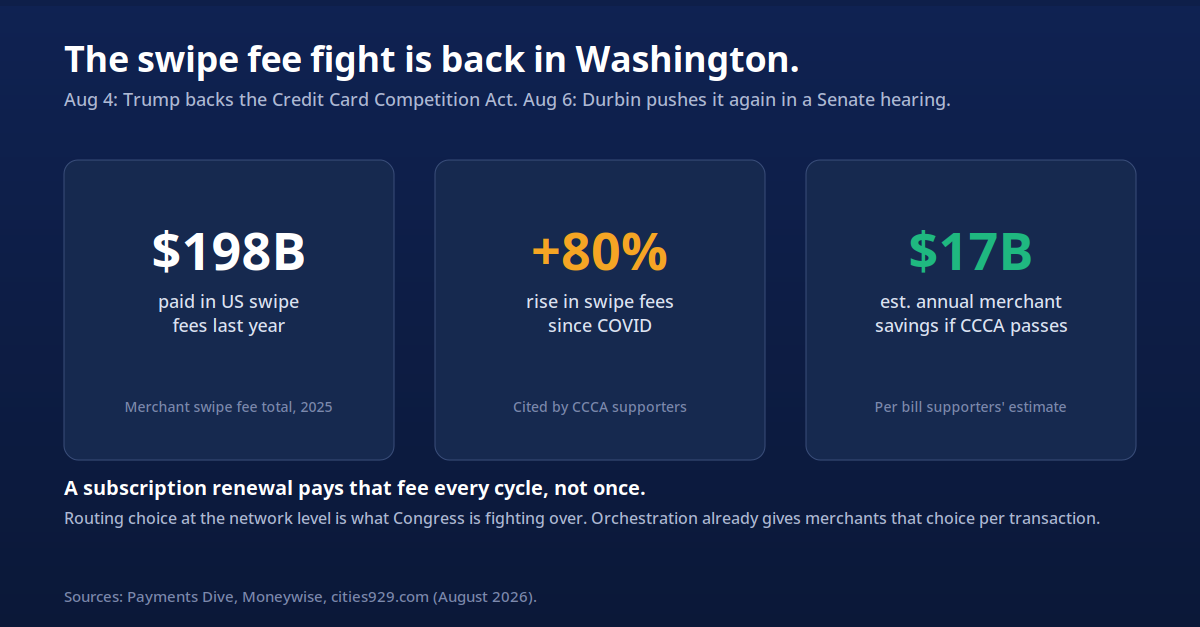
- The CCCA would require banks with more than $100 billion in assets to give merchants a routing choice beyond Visa and Mastercard on every card transaction. US merchants paid $198 billion in swipe fees last year, up more than 80% since COVID.
- Routing choice at the network level is the mechanism at stake in Washington. Payment orchestration already gives merchants that choice at the transaction level today, independent of whether the bill ever passes.
What happened
On Monday, August 4, 2026, President Trump posted on Truth Social while endorsing Kansas Senator Roger Marshall’s reelection bid: “Roger is working tirelessly to pass the Credit Card Competition Act, in order to stop the out of control Swipe Fee ripoff!” It was not the first time Trump had backed the bill; he voiced support for it in January 2026 as well.
Two days later, on August 6, Senator Dick Durbin, the bill’s Democratic co-sponsor, advocated for it again during a Senate subcommittee hearing. Durbin and Marshall first introduced the Credit Card Competition Act in 2022. It has stalled repeatedly since, most recently when it was excluded from a Senate housing bill in March 2026.
The bill’s mechanism is narrow but consequential: banks with more than $100 billion in assets would have to enable at least one payment network unaffiliated with Visa or Mastercard for merchants to route transactions over, rather than defaulting to whichever of the two networks issued the card. It mirrors the debit-card routing rules Durbin authored in 2010, extended to credit cards.
Supporters, including the Merchants Payments Coalition and the National Association of Convenience Stores, argue the bill could save merchants an estimated $17 billion a year. Opponents, led by the Electronic Payments Coalition representing card networks and issuing banks, call it a government mandate that risks card security and rewards programs, and argue smaller merchants (under $500 million in annual revenue) are unlikely to see much benefit in practice.
The numbers underlying the debate are not in dispute. Swipe fees, the combined interchange and network fees that card networks and issuing banks collect on every card transaction, have climbed more than 80% since COVID. US merchants paid $198 billion in swipe fees last year. Card processing costs, all-in, still run at roughly 2% to 2.2% of transaction value for most merchants regardless of size.
Why this is a subscription-billing problem, not just a swipe-fee fight
A retail merchant pays a swipe fee once, at the moment of sale. A subscription business pays the same percentage on the same customer every billing cycle, for as long as that customer stays subscribed. A $50 monthly SaaS renewal charged at 2.2% costs about $1.10 in swipe fees. Multiplied across a full year of renewals, and across a customer base measured in months of average retention, that percentage stops looking like a rounding error on a receipt and starts looking like a line item against monthly recurring revenue.
The CCCA debate is fundamentally about who controls the routing decision on each transaction: the issuing bank and its default network, or the merchant. That is the leverage point. A merchant that can route a transaction to a lower-cost, still-approving network on a $50 renewal keeps more of that $50 without changing the price the customer sees.
The practical problem for most subscription businesses today, with or without the CCCA, is that having a legal right to a routing choice and having a system that can act on that choice, transaction by transaction, in real time, are two different things. Most billing stacks default to whatever network the card issuer selects and never evaluate the alternative.
How orchestration architecture addresses this
This is where payment orchestration already does, structurally, what the CCCA is trying to mandate at the bank level. SGW Payment connects merchants to a network of payment providers through a single SDK and API integration, and routes each transaction to the provider most likely to approve it, which lifts success rates and lowers the fees paid on each payment. That routing decision happens per transaction, not once at account setup, and it does not wait on Congress to pass a bill that has been stalled since 2022.
For subscription businesses operating in multiple markets, the same logic compounds with SGW’s role as the payments infrastructure layer for international expansion. When transactions process locally in a given market rather than crossing borders, issuer approval rates rise on their own, and that gain stacks with the routing layer’s fee and approval optimization. A merchant expanding into a new country would otherwise need 6 to 12 months to stand up the local banking, acquiring, and PSP relationships required to get any routing choice at all in that market. Orchestration compresses that timeline by handling the setup on the merchant’s behalf.
To be precise about scope: SGW does not lobby on or take a position on the Credit Card Competition Act, and nothing here claims a specific SGW fee-reduction percentage. The claim is structural: the routing flexibility the bill is fighting to require by law is a capability orchestration already provides today, on every transaction, regardless of the bill’s outcome.
Takeaways you can act on this quarter
- Model swipe fees as a percentage of MRR, not just cents per transaction. A fee schedule that looks trivial on a single sale compounds very differently against a subscription base with months of average retention.
- Ask whether your billing stack can already act on routing choice. A legal right to route around a network means nothing if nothing in your stack evaluates the alternative on a live transaction.
- Track the CCCA’s progress, but don’t wait on it. The bill has stalled since 2022 and was cut from a Senate housing bill as recently as March 2026; orchestration-level routing does not require it to pass.
- If you’re expanding into a new market, price in the setup timeline. Standing up local banking, acquiring, and routing infrastructure from scratch typically takes 6 to 12 months; that timeline is itself a cost of not orchestrating from day one.
Sources
- Trump backs card bill, again (Payments Dive, August 2026)
- Trump supports, processors oppose Durbin swipe fee bill (August 6, 2026)
- Trump backs Credit Card Competition Act again, calling $198 billion in swipe fees a ‘ripoff’ for merchants and consumers (Moneywise)
About SGW Payment. SGW Payment helps online businesses capture more revenue and reduce processing costs. Through a single SDK and API, SGW connects merchants to a network of payment providers and routes each transaction to the provider most likely to approve it. On top of the technology, SGW acts as the payments infrastructure layer for international expansion, standing up the local payments stack (entity, banking, and finance operations) in every new market, so transactions process locally rather than cross-border. Learn more at sgw-payment.com.