TL;DR
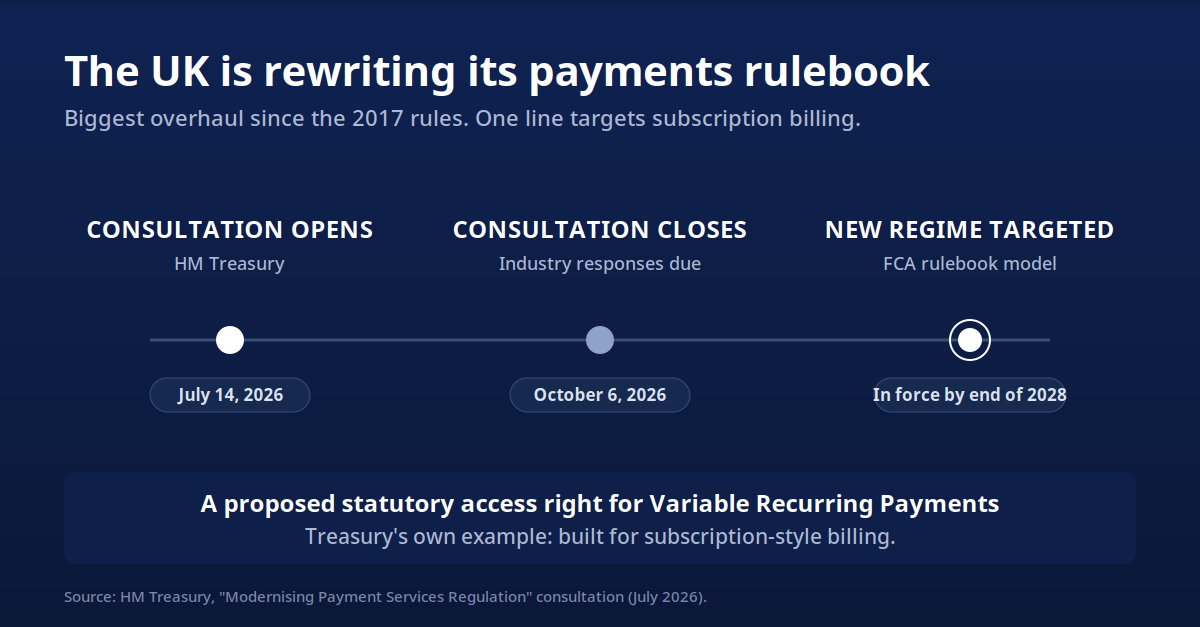
- On July 14, 2026, HM Treasury opened a 12-week consultation, closing October 6, 2026, on the largest overhaul of UK payment services and e-money regulation since the Payment Services Regulations 2017 and Electronic Money Regulations 2011 first took effect.
- The plan moves most technical, firm-facing requirements out of primary legislation and into the FCA’s rulebook, and separately proposes a new statutory right of access for Variable Recurring Payments (VRP), the open banking mechanism law firms are flagging as built for subscription-style recurring billing.
- For subscription businesses selling into the UK, the near-term takeaway isn’t a new rail arriving overnight. It’s that the rules governing every existing UK rail, cards included, are about to start moving faster, and the local infrastructure needed to keep pace is exactly what takes 6 to 12 months to build independently market by market.
What actually happened
On July 14, 2026, HM Treasury published “Modernising Payment Services Regulation,” a consultation the Government frames as part of its National Payments Vision agenda. Law firms tracking the filing describe it as the most significant restructuring of the UK payments regime since the Payment Services Regulations 2017 (PSRs) and Electronic Money Regulations 2011 (EMRs) were introduced.
The core structural move is to shift detailed, technical, firm-facing requirements out of an Act of Parliament and into rules set by the Financial Conduct Authority (FCA), the UK regulator that supervises payment and e-money firms. Core consumer protections and the boundaries of what counts as a regulated payment activity would stay in statute. Everything more detailed would move into the FCA Handbook, where the regulator can update it directly.
Three other reform threads run through the same document. First, a proposed right of access for Variable Recurring Payments (VRP), an open banking mechanism that lets a customer authorize a bank to make a series of payments up to a set limit, rather than approving each transfer individually. Second, a framework for tokenised payments, so the same payment permissions could apply whether money moves as fiat, a tokenised deposit, or a UK-issued stablecoin. Third, a request for feedback on rules for “agentic” payments, where software agents initiate transactions on a customer’s behalf, covering consent, authentication, and who is liable when something goes wrong.
The consultation runs 12 weeks and closes on October 6, 2026. Government’s own delivery plan points to an aim of having the new regime in force by the end of 2028, though that timeline is described as an aspiration rather than a commitment.
Why this changes decisions for subscription businesses
Two separate proposals in the same document are each worth tracking on their own. Together, they change the planning problem for anyone billing UK customers on a recurring basis.
The VRP access right is the more direct one. Open banking payments already exist in the UK, but VRP for recurring, subscription-style billing has lacked a clear, universal right of access; banks have offered it selectively, often only for narrow use cases like moving money between a customer’s own accounts. A statutory right changes that calculus. If it lands as proposed, VRP becomes a formal option for UK recurring billing alongside cards and direct debit, each with its own consent flow, dispute mechanics, and failure modes that a subscription business would need to support.
The structural move (legislation into FCA rules) is less visible but larger in scope. It doesn’t add a new rail. It changes how fast every existing rule can change. A requirement that currently needs a Parliamentary process to amend could, once inside the Handbook, be updated through the FCA’s ordinary rulemaking process. For a compliance or payments team, that turns “check the rules once a year” into “monitor the FCA’s rulebook the way you’d monitor a scheme’s bulletin calendar.”
Layer the tokenised-payments and agentic-payments threads on top and the direction is consistent: UK payments regulation is being rebuilt as a framework that can absorb new payment methods and new categories of payer (a card, a bank account, a stablecoin, an AI agent) without a fresh Act of Parliament each time. That is good news for the rate of innovation. It is also a signal that the UK rulebook a subscription business complies with today will look different by the time VRP access rights, tokenised payment rules, and agentic-payment liability rules actually land.
How SGW’s infrastructure layer absorbs this
None of this is a call to bet on VRP, or on any single rail, before the consultation even closes. It’s a call to not have the entire UK payments stack depend on rebuilding it every time the rulebook moves.
SGW Payment’s role as the payments infrastructure layer for international expansion is built for exactly that condition. When a client enters a market like the UK, SGW stands up the local setup on the client’s behalf: incorporating entities where required, opening banking and acquiring relationships, negotiating PSP (payment service provider) contracts in the jurisdiction, and running the downstream finance operations, reconciliation, cash flow, reporting, and local tax clearance. That local infrastructure is what a new access right or a faster-moving rulebook lands on top of. It doesn’t have to be rebuilt from scratch every time the FCA updates a rule.
On top of that infrastructure, SGW’s routing connects clients to a network of payment providers through a single SDK and API, and routes each transaction to the provider most likely to approve it. If VRP becomes a live acceptance option in the UK the way this consultation proposes, that is a routing and provider-network question, not a rebuild-the-UK-stack question, for a business whose local plumbing is already in place.
To be precise about what this is not: SGW does not track or interpret regulatory change on a client’s behalf. The reading of a consultation like this one, and the compliance judgment calls it requires, stays with the business and its counsel. What SGW’s model changes is how much has to be rebuilt in the UK, or in any other market, once those judgment calls are made.
Takeaways you can act on this quarter
- Read the consultation, or have counsel do it, before October 6. HM Treasury is explicitly asking industry for input on the FCA-rulebook shift, the VRP access right, and the agentic-payments liability questions. A response window this open doesn’t stay open long.
- Map where VRP would sit in your UK billing stack today. If it becomes a genuine recurring-billing rail, it needs its own consent flow, dispute path, and reconciliation feed, the same way a new card BIN (Bank Identification Number) range or a new PSP does.
- Separate “new rail” risk from “faster rulebook” risk. VRP access is one proposal inside a much larger structural change. Even if VRP goes nowhere, moving detailed requirements into the FCA Handbook changes how often your UK compliance posture needs a fresh look.
- Price in the lead time. Standing up local entity, banking, and acquiring relationships in a new market independently can take 6 to 12 months. A rulebook that can now move faster than that build timeline is itself a reason to have that infrastructure in place ahead of the next change, not after it.
Sources
- Modernising Payment Services Regulation. HM Treasury consultation (GOV.UK, opened July 14, 2026)
- HM Treasury Proposes Major Overhaul of UK Payments Regulation. Skadden, Arps, Slate, Meagher & Flom (July 2026)
- United Kingdom: Consultation on Modernisation of Payments Regulation. Baker McKenzie (July 2026)
- Modernising UK payments: HM Treasury’s proposed overhaul of the payment services regime. A&O Shearman (July 2026)
About SGW Payment. SGW Payment helps online businesses capture more revenue and reduce processing costs. Through a single SDK and API, SGW connects merchants to a network of payment providers and routes each transaction to the provider most likely to approve it. On top of the technology, SGW acts as the payments infrastructure layer for international expansion, standing up the local payments stack (entity, banking, acquiring, and finance operations) in every new market, so transactions process locally rather than cross-border. Learn more at sgw-payment.com.