TL;DR
- On July 9, 2026 the European Parliament approved its negotiating mandate for the digital euro (416 to 169), trilogue talks opened days later, and the European Central Bank named 36 payment providers for a 12-month pilot in 2027, with a first issuance possible around 2029.
- For subscription businesses, the near-term takeaway is not the digital euro itself. It is that Europe’s payment rail mix is fragmenting: cards, account-to-account wallets like Wero, and a coming central bank digital currency each add integration, acceptance, and reconciliation work in every market.
- An orchestration layer plus local per-market payments infrastructure is the structural hedge. It lets a merchant absorb a new rail without re-plumbing its stack country by country.
What actually happened
Two things moved in the same week, and together they matter more than either alone.
First, the legislation. On July 9, 2026 the European Parliament approved its negotiating mandate for the digital euro by 416 votes to 169, with 22 abstentions. That cleared the way for trilogue negotiations between the Parliament, the Council, and the European Commission, which opened on July 13, with the aim of finalising the legislative framework by the end of 2026.
Second, the infrastructure. Days later, the European Central Bank named 36 payment providers, chosen from more than 50 applicants, to take part in a 12-month digital euro pilot in the second half of 2027, alongside 19 euro-area national central banks. The ECB has said a first issuance could follow around 2029.
A digital euro is a central bank digital currency (CBDC): electronic money issued directly by the ECB and distributed through banks and other payment service providers. The motivation is openly strategic. ECB President Christine Lagarde has framed it as a question of sovereignty, noting that Europe depends predominantly on US, and sometimes Chinese, networks to organise payments, and needs a European option.
Why this changes decisions for subscription businesses
The sovereignty debate will run for years. The operational consequence starts now.
For most of the card era, a merchant in Europe could reach almost every customer through a single rail. Acceptance, approval behavior, dispute handling, and reconciliation were broadly one problem, solved once. That assumption is unwinding.
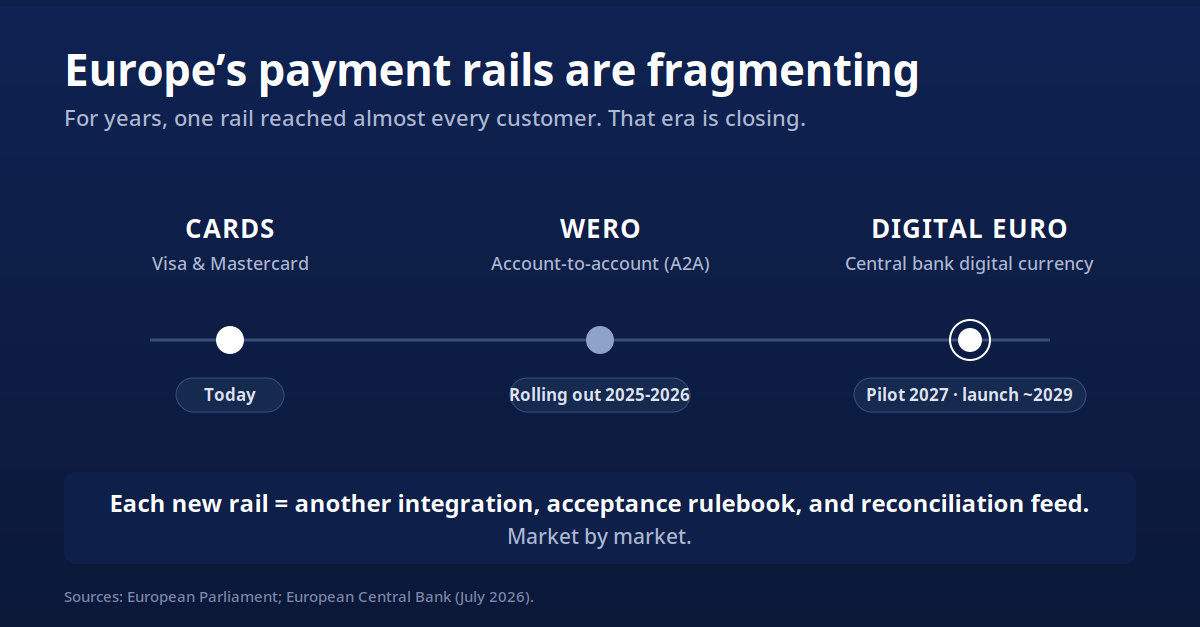
Wero, the account-to-account (A2A) wallet backed by a consortium of European banks, is rolling out across euro markets, with the Netherlands migrating from iDEAL and further e-commerce coverage arriving through 2026. The digital euro now sits on the roadmap behind it. Add the cards that are not going anywhere, and a subscription business selling across several EU markets is looking at a rail mix that grows rather than consolidates.
Every rail carries its own operational weight. A card renewal that fails can be retried and rerouted. An A2A debit follows different consent and refund mechanics. A CBDC will arrive with its own acceptance rules, still being written in the trilogue now. Each one is a separate integration to build, a separate acceptance rulebook to follow, and a separate reconciliation feed to close every month, repeated market by market.
For recurring revenue, that complexity lands squarely on involuntary churn (revenue lost to failed payments rather than cancellations) and on margin. A charge that used to have one path to approval soon has three or four, each performing differently by market and by issuer.
How orchestration architecture absorbs this
The merchants who feel rail fragmentation least are the ones who never hard-wired their stack to a single rail or a single provider in the first place.
That is the case for an orchestration layer. Through one integration, a merchant connects to a network of payment providers, and each transaction routes to the provider most likely to approve it, rather than the business maintaining and monitoring every rail in every market itself. When a new rail becomes commercially relevant, the integration work is absorbed by the layer, not rebuilt by the merchant.
The second half of the problem is local. Rails like the digital euro and Wero are inherently market-specific, governed and settled in Europe. This is where SGW Payment’s model applies: on top of routing, SGW acts as the payments infrastructure layer for each market a client sells into, standing up the local setup (entity, banking, acquiring relationships, PSP contracts) and running the downstream finance operations, including reconciliation, reporting, and local tax clearance. Transactions then process locally in each market rather than cross-border, which lifts issuer approval rates and compounds with the routing layer.
Neither point requires betting on which rail wins. It requires not betting the whole stack on one.
Takeaways you can act on this quarter
- Map your European rail exposure now. List the markets you bill in, the rails you support in each today, and the ones on the horizon (Wero live and expanding, the digital euro in pilot for 2027). Treat the number of direct rail integrations per market as a cost and risk line, not a given.
- Favor an architecture that abstracts providers and rails. If adding a rail means re-plumbing your checkout and billing in every country, fragmentation will keep taxing your roadmap. A single orchestration layer turns each new rail into a configuration change rather than a project.
- Price in the lead time. Standing up local processing in a new market on your own can take 6 to 12 months. As the rail mix widens, that lead time is the real cost of going market by market alone.
- Watch the trilogue. Merchant acceptance rules for the digital euro are still being negotiated. The outcome decides how much of this becomes mandatory, and when, so keep it on the finance and payments roadmap even though issuance is years out.
Sources
- ECB selects 36 payment providers for digital euro pilot as the project moves ahead. Euronews (July 14, 2026)
- Digital euro: Parliament says ‘yes’; inter-institutional negotiations to start on 13 July. Eunews (July 9, 2026)
- Digital euro pilot. European Central Bank
- Digital euro enters trilogues: what the Council and Parliament positions mean for banks and payment providers. Freshfields
- Wero: Shaping the future of European payments. European Payments Council
About SGW Payment. SGW Payment helps online businesses capture more revenue and reduce processing costs. Through a single SDK and API, SGW connects merchants to a network of payment providers and routes each transaction to the provider most likely to approve it. On top of the technology, SGW acts as the payments infrastructure layer for international expansion, standing up the local payments stack (entity, banking, acquiring, and finance operations) in every new market, so transactions process locally rather than cross-border. Learn more at sgw-payment.com.