TL;DR
- On May 5, 2026, the European Parliament’s ECON Committee approved the final text of the Payment Services Regulation (PSR) — 50 votes in favour, 2 against, 2 abstentions. The Parliament plenary vote follows later this month. PSR is the regulation that sits alongside PSD3 and rewrites how recurring card billing works in the EU.
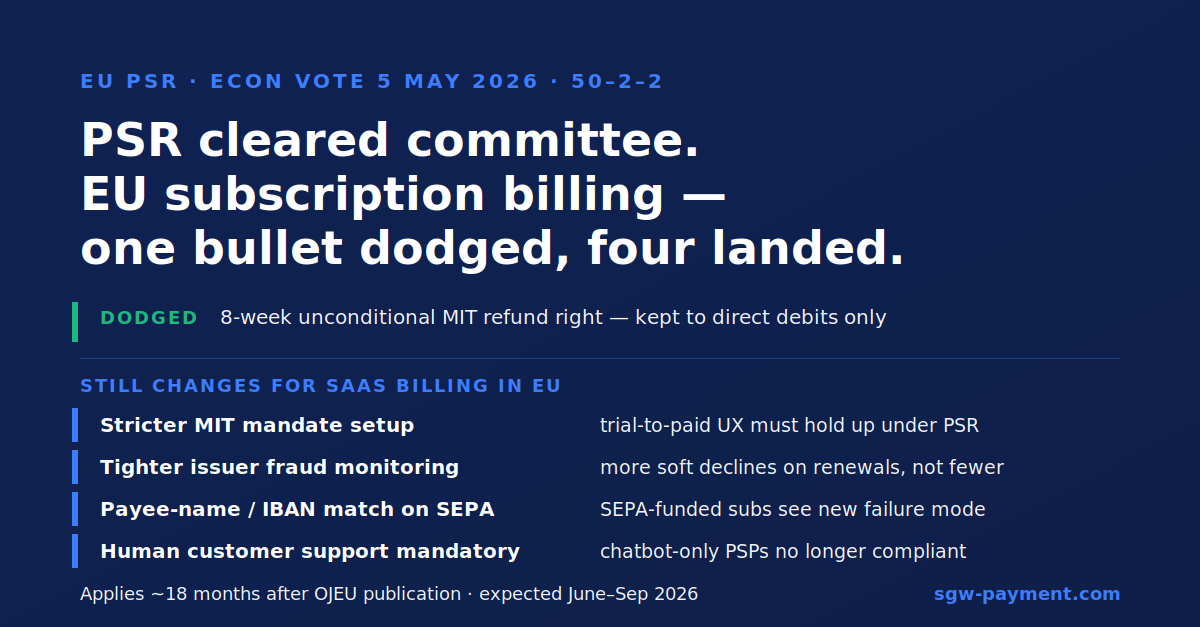
- The most important outcome for subscription billing: the Commission’s proposed 8-week "no questions asked" refund right was NOT extended from direct debits to all Merchant-Initiated Transactions (MITs). SaaS, streaming, and recurring digital billing avoided the worst-case scenario.
- Four other PSR elements still change EU subscription billing in the next ~18 months: stricter MIT mandate setup, tighter issuer-side fraud monitoring (expect more soft declines on renewals), mandatory IBAN/name verification on SEPA credit transfers, and mandatory human customer support.
Context: what happened on May 5
The PSR + PSD3 file has moved fast. The Parliament and the Council of the EU reached political agreement on November 27, 2025. Final compromise texts were endorsed by COREPER on April 22, 2026, and published on April 23, 2026. On May 5, 2026, the ECON Committee approved both texts — 50–2–2 on the PSR, 55–3–5 on PSD3.
The Parliament plenary vote is expected later in May. After legal-linguistic review, publication in the EU’s Official Journal is anticipated for June–July 2026, possibly slipping to September. PSR generally applies 18 months after entry into force. The payee-name verification obligation on SEPA credit transfers applies 24 months after entry into force to allow system changes.
Practical horizon for subscription businesses: most of PSR lands in early-to-mid 2028.
Analysis: the MIT refund-right fight, and why it mattered
Most of the noise from the merchant lobby during the trilogue was about Article 62 of the Commission’s PSR proposal — and rightly so. The proposal would have extended the SEPA direct-debit refund regime to all MITs: a payer could request an automatic refund from their PSP within eight weeks of any MIT, no questions asked. Subscription verticals (streaming, SaaS, gaming) warned that this would have made the first two months of every renewal cycle reversible at will. Bad actors could have consumed two months of content per signup before pulling the money back.
Industry coalitions (Ecommerce Europe, eurocommerce, the European Tech Alliance, the European VOD Coalition) pushed hard against the extension. The Parliament’s compromise text limited the unconditional 8-week refund to direct debits. The final PSR retains that narrowed scope.
In plain English: a customer’s bank can still help them claw back a card-funded subscription charge under the existing conditional regime — same as under PSD2 — but the EU did not invent a new "no-questions-asked" reversal channel for MITs. Renewals stay recoverable revenue.
What still changes for EU subscription billing
Even with Article 62 narrowed, the PSR + PSD3 package shifts four operational levers that any subscription business billing EU consumers needs to track.
1. Stricter MIT mandate setup. PSR tightens the consent and disclosure framework that has to be in place when a customer agrees to recurring billing. The trial-to-paid flow, the in-app upgrade flow, the dunning re-auth flow — all of them need to capture and store mandate evidence that holds up under PSR’s clarified requirements. The exact wording of the mandate, the way the recurring frequency and amount range are surfaced to the consumer, and the audit trail will all matter more than they do today. This is a UX and product-engineering task, not just a legal one.
2. Tighter issuer-side fraud monitoring expectations. PSR raises the bar for issuer fraud monitoring obligations and broadens the cases in which PSPs share liability for fraud. The predictable second-order effect: issuers will tune their decline models to be more conservative on edge cases — especially on cross-border MITs without 3DS, on cards that have recently been involved in a dispute, and on renewals after a cardholder complaint. Expect more soft declines on renewals in the EU, not fewer.
3. Mandatory payee-name / IBAN verification on SEPA credit transfers. PSR makes payee-name verification (often called "Verification of Payee" or VoP, already mandated separately under the Instant Payments Regulation) a permanent obligation for all SEPA credit transfers, with corresponding liability allocation. Subscription businesses billing EU consumers via SEPA Direct Debit are not directly in scope of this article, but anyone running SEPA credit transfer invoicing for B2B SaaS — or relying on SEPA payouts to merchants and creators in a marketplace model — will see a friction layer added at the bank rail level. Mismatched account-name fields will fail more often.
4. Mandatory human customer support. PSR codifies that PSPs must offer access to human customer support, not chatbot-only flows, and must join alternative dispute resolution schemes where the consumer opts in. This is an obligation on PSPs, but it reshapes the dispute-resolution landscape that subscription merchants operate in. A consumer who hits a billing issue will increasingly have a clean path to a human at their bank — which can pull disputes earlier into the issuer-side process and away from merchant-side cancellation flows.
How payment orchestration absorbs the PSR shift
PSR’s biggest operational impact on subscription billing is not the legal text — it’s the second-order behavior change on the issuer side. When the regulation pushes issuers toward stricter fraud monitoring, the immediate consequence is decline-rate creep on renewals: more soft declines, more issuer-side step-up requests, more BIN-specific behavior changes that single-PSP setups absorb as silent revenue loss.
Payment orchestration is the layer that catches that loss before it shows up in MRR.
- Cascading PSP routing across pre-integrated EU acquirers lets a soft decline on PSP A’s acquirer retry against PSP B’s acquirer — same card, same customer, different scheme path. Decline-rate uplift gets absorbed by the next hop, not the customer.
- Issuer- and BIN-aware retry logic treats a soft decline from a German cooperative issuer differently from a soft decline from a UK challenger bank. Retry windows, 3DS step-up choices, and PSP routing all adapt per issuer profile. PSR pushes issuer fraud models in different directions across the EU; one global retry policy will lose margin to a per-issuer one.
- Multi-MID EU footprint and MID strategy means a SaaS business billing EU consumers can hold multiple licensed MIDs across EU acquirers and re-balance volume per country, currency, and card brand. As PSR’s IBAN/name verification and fraud-monitoring rules ripple through PSP-issuer relationships, having more than one rail to fail over to becomes the difference between flat decline rates and quietly rising involuntary churn.
This is not about being "PSR-compliant" — that obligation sits with the PSP. It is about absorbing the operational fallout from a regulation that makes issuers more cautious on subscription renewals.
Takeaways
- The PSR’s worst-case scenario for SaaS billing — universal 8-week MIT refunds — did NOT make it into the final text. Recurring card billing in the EU stays recoverable revenue.
- The PSR text now moves to the Parliament plenary later in May, then publication in the OJEU (June–September 2026), then 18 months to apply (~early-to-mid 2028 for most articles, 24 months for SEPA payee verification).
- The biggest operational impact on subscription billing is the second-order issuer behavior: tighter fraud monitoring expectations will push soft declines on renewals up across the EU.
- Audit your MIT mandate-setup UX now. The wording, frequency disclosure, and audit trail get scrutinized harder under PSR.
- Multi-PSP cascading routing and issuer/BIN-aware retry logic are how you absorb decline-rate creep without it landing on MRR. Single-PSP, one-size retry policies will leak margin first.
Sources
- ECON Committee vote on the PSR — 5 May 2026 (Blockchain WG)
- ECON Committee vote on PSD3 — 5 May 2026 (Blockchain WG)
- MEPs in committee approve EU payment services reform (Agence Europe)
- PSD3 breakthrough: EU legislators agree payments regulation reforms (Linklaters)
- PSD3/PSR: Final compromise texts published (Lexology)
- Final texts for PSD3 and PSR awaited (Hogan Lovells)
- PSD3 and PSR: From provisional agreement to 2026 readiness (Norton Rose Fulbright)
- PSD3/PSR: What the EU’s new payments rules mean for your business (Freshfields)
- Joint Statement on the treatment of MITs under the PSR (Ecommerce Europe)
- MIT changes could have unintended consequences (Vixio)
About SGW Payment — SGW Payment is a payment orchestration platform built for global digital subscription businesses. With one API, SGW connects merchants to a network of PSPs and acquirers, intelligently routes every transaction for the best success rate and lowest cost, and reconciles fees end-to-end — so payments stop being a constraint and start being a growth lever. Learn more at sgw-payment.com.