Category: Insights

When Your PSP Buys Your Billing Engine: What Adyen’s $335M Orb Acquisition Means for Subscription Merchants

Adyen agreed to acquire enterprise billing platform Orb for $335 million, with the deal closing July 1, 2026. Adyen’s long-term goal is to converge billing and payments into a single platform. For subscription merchants, the structural hedge is an independent routing architecture: multi-provider routing with local acquiring in each market, operating regardless of which vendor runs the billing engine.

Read More »

What Visa’s Enhanced Subscription Manager Means for Subscription Billing Success Rates

Visa’s Enhanced Subscription Manager lets cardholders view, switch, and cancel 150+ subscriptions inside their banking app, starting with North American issuers in summer 2026. For subscription businesses, this shifts the cancellation path to the bank: a failed renewal now surfaces at the same screen where subscribers can act on it immediately. The merchants who win are those with the highest authorization rates on recurring charges — routing each transaction to the most-likely-to-approve provider is now a churn defense, not just a revenue metric.

Read More »

What the EU’s PSD3 and PSR Mean for Cross-Border Subscription Billing

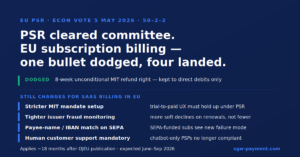
The EU’s new payments package (PSD3, a directive, and PSR, a directly-applicable regulation) is expected to reach the Official Journal around mid-2026, starting a phased compliance clock of roughly 18 to 24 months. For subscription businesses charging EU cardholders, the changes touch checkout (SCA and surcharging), fraud liability (shifting toward payment providers), and account verification (mandatory payee name matching). The operational weight lands on businesses that bill the EU market by market: the rules attach to local entities, acquiring, and PSP relationships, not to a single cross-border setup.

Read More »

What Mastercard’s Fraud Deflect Move Means for Subscription Billing’s Defense Stack

On 4 May 2026, Mastercard announced a partnership with Fraud Deflect, integrated into Mastercard’s Ethoca Consumer Clarity Smart Subscriptions, a subscription-management layer embedded inside cardholder banking apps. When a customer taps “dispute” on a recurring charge from inside the app, the merchant gets a window to resolve directly before the dispute becomes a chargeback. Mastercard’s own framing: about a quarter of its chargebacks come from recurring transactions tagged as cancellation confusion or forgotten purchases, against a backdrop of 8+ active subscriptions per US consumer and roughly $118 a month in subscription spend. The mechanism is a downstream save: it fires once the cardholder is already on the dispute path. The cheaper dispute is the one that never starts, which is an upstream payment-quality story (descriptor, local acquirer, retry sequencing) rather than a save-engine story.

Read More »

Why a Single-PSP Subscription Stack Is Now a Vendor-Risk Bet

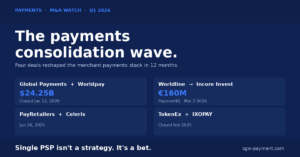
Three M&A waves crashed through the merchant payments stack over the last 12 months: Global Payments closed its $24.25B acquisition of Worldpay on January 12, 2026; the orchestration vendor base consolidated (Worldline/PaymentIQ €160M, PayRetailers/Celeris, TokenEx/IXOPAY); and Global Payments separately swallowed takepayments in the UK. The post-Worldpay Global Payments now sits across 6 million merchant locations, $3.7 trillion in volume, and 175 countries. Counterparty concentration just rose at every layer of the merchant payments stack. For subscription companies, single-PSP architecture is no longer a sourcing decision — it’s a bet on the M&A activity of one private-sector counterparty. Orchestration absorbs the bet.

Read More »

Three Visa April 2026 Rule Changes That Just Shifted Subscription Billing Margin

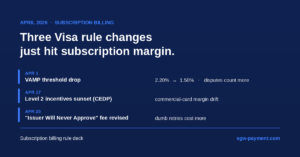
Visa rolled out three subscription-billing-relevant rule changes between April 1 and April 25, 2026: the VAMP “Excessive” dispute threshold dropped from 2.20% to 1.50%, Level 2 commercial-card interchange incentives sunset under CEDP, and the international “Issuer Will Never Approve” reattempt fee was revised. The compound effect for subscription companies: dumb retries cost more, disputes count more, and B2B commercial-card cohorts drift to higher-cost tiers without enriched data. The durable answer is cascading PSP routing across multiple acquirers, decline-code-aware retry logic, and a multi-MID volume strategy — not a denser dunning loop.

Read More »